How Humidity And Monsoon Season Affect Cooling
In most of the country, maintenance is good practice. In Arizona it is closer to a necessity: systems here run thousands of hours a year in dust and.
H Reviewed By Hamza · Lead HVAC & AC Repair Technician Updated October 26, 2026·8 Min Read
Quick Answer
In most of the country, maintenance is good practice. In Arizona it is closer to a necessity: systems here run thousands of hours a year in dust and extreme heat. This guide explains what a proper visit covers, what separates it from a quick glance, and how to judge whether yours was done correctly.
What Does Proper Maintenance Actually Cover?
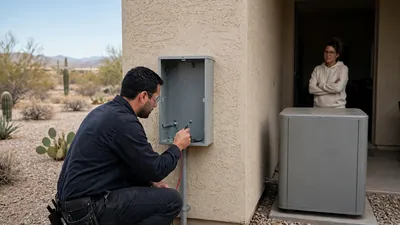
A real maintenance visit is a list of measurements and minor jobs: both coils cleaned, the condensate drain flushed, the capacitor and contactor tested under load, electrical connections checked, refrigerant readings taken, airflow verified. If a 'service' involves none of that, it was a visit, not maintenance.
The logic is straightforward: each typical Arizona failure starts as a minor, findable condition — a drifting capacitor, a gradual drain, a coil loading with dust, a charge creeping low. Maintenance is the appointment where those conditions are cheap. Everything in this guide follows from that one idea. Surge protection is the storm topic nobody raises until a board dies. In Arizona, where summer storms are a certainty, a surge protector on the system is inexpensive insurance for the control board and the variable-speed motors modern systems depend on. Ask about it at any visit. In Arizona, a central air conditioner is the hardest-working system in the home.
When Is The Correct Time In Arizona?
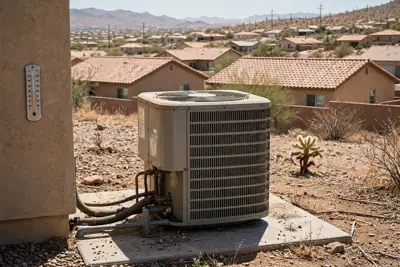
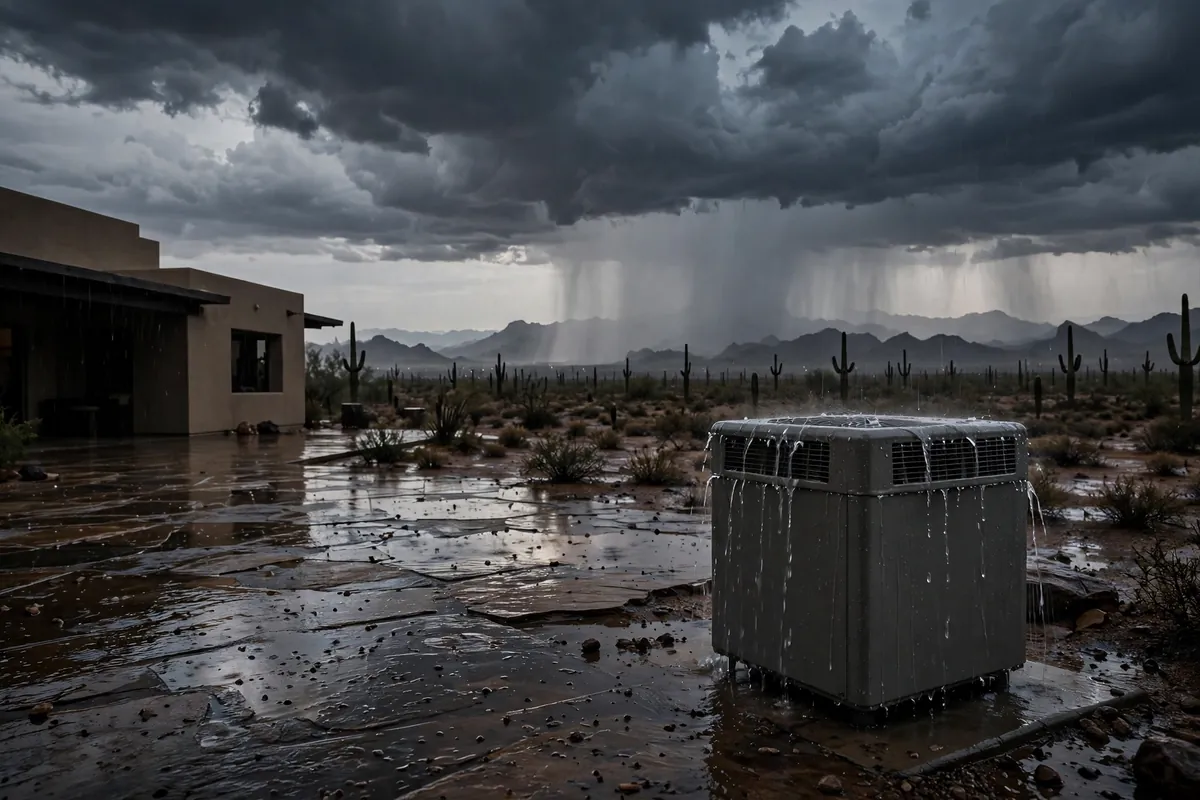
The dust arrives first, at times as a wall of it. A condenser that was clear in June can be felted over by August in Arizona. Then the rain turns drain dust to sludge. Local pros plan for it: post-storm tests of coil, drain and electrical sections are typical practice in monsoon country.
Wind-driven rain also finds cracked drain pans and tired seals. If a Arizona system odors musty after storms, or the drain seems slower, that is monsoon evidence — worth a service call in the calm after the storm rather than an emergency in the next heat wave. The trap in the drain line is where most clogs begin in Arizona. Water slows there by design, dust settling out of it builds season by season, and monsoon moisture gives the growth in the line precisely what it wants. A drain that gurgles, drains slowly or odors sour near the handler is describing a clog while it is still simple to clean.
What Can You Do Yourself Between Visits?
Arizona systems produce gallons of condensate on humid monsoon days. The drain line is a narrow pipe with a trap, and it clogs where the water slows. In Arizona, the first signal is often a musty smell or a system that stops with a full pan — the float switch shutting it down before the ceiling pays for it.
Clearing a drain clog in Arizona means flushing the line, cleaning the trap and checking the pan and float switch, not only poking the blockage via. Pros also prove the line's slope: a sagging run holds water permanently and re-clogs within the season no matter how well it is cleaned. Registers partly closed, furniture over floor registers and rugs across returns quietly steal airflow in Arizona homes. None of them will show up as a failed section, since no section has failed. A thorough visit looks at the entire path the air travels, from return to register, which is why some airflow issues are solved by moving what years of living piled up. Residents comparing AC Repair Surprise, AZ options will recognise the same pattern: the readings decide, not the sales pitch. The vocabulary matters here: the condenser unit outside holds the compressor and the condenser coil, while the evaporator coil sits indoors at the air handler. The run capacitor and contactor begin the motors, and a hard start kit assists an ageing compressor do the same against pressure.
What Does Skipping A Year Truly Price?
Feeble airflow in Arizona comes from resistance somewhere along the air's path: a loaded filter, a dust-caked blower wheel, damaged or disconnected ducts, or a motor losing strength. Pros measure static pressure and vent output to locate it instead of guessing.
Compare the registers across your Arizona home before you call, since the comparison is diagnostic. Air feeble everywhere points back toward the filter, blower or coil, while air powerful in most rooms and feeble in one points toward that room's duct run. A pro will still measure, but that straightforward observation from the homeowner often aims the first inspection properly. A practical rhythm for Arizona: check monthly, change when light no longer passes via the media evenly, and always after monsoon dust storms. It is the single cheapest act of maintenance in the home, and the one whose neglect fills emergency call lists.
Need A Pro To Look At Your AC?
One free call connects you with a local pro — typically arriving in 30–60 minutes.
Call Free — (800) 555-0100Tune-Up, Service, Maintenance — What Is The Difference?
Expect honesty about what is found. A good service ends with a short report: readings, anything worn, anything to plan for. 'All fine' is a valid report when it is backed by numbers. What you should not accept is a service that turns into a sales pitch for sections nobody tested.
The visit's order matters. Cleaning first, since filthy coils corrupt each reading after. Then the drain, since it is the fault most prone to damage the house. Then electrical testing under load, then refrigerant readings — superheat and subcooling — and airflow. A pro working in that order leaves with a true picture of the system, not a set of guesses. The morning after a storm is the time to look in Arizona. Walk the outdoor system for debris lodged in the coil face, check that nothing has fallen against the cabinet, and glance at the filter indoors. That short round catches the storm's leavings while they are still litter to take out, instead of the gradual overheating they cause over next weeks. Residents comparing AC Repair Tucson, AZ options will recognise the same pattern: the readings decide, not the sales pitch. Residents comparing AC Repair Kingman, AZ options will recognise the same pattern: the readings decide, not the sales pitch. Modern systems are charged with R-410A or the newer R-454B, and the charge is set by superheat and subcooling, not by feel. A float switch guards the drain pan, and the condensate drain line carries away the water the coil pulls from the air.
What Should The Pro Leave You With?
Set maintenance price against failure price and the arithmetic is not close. The faults a service catches — starting sections, drains, filthy coils — are the cheapest repairs in the trade. The faults they become in July — compressors, water damage, emergency callouts — are the most expensive. One visit a year is the toll; the alternative is paying at the worst moment, at the worst prices.
There is also the operating-price side: a cleaned, properly charged system uses measurably less electricity to do the same cooling, and in Arizona the system runs sufficient hours for that difference to show on real bills. Maintenance pays twice — once in avoided repairs, once each month on the meter. Secondary pans and attic handlers lift the stakes in Arizona homes. A system above finished ceilings has nowhere forgiving for overflow to go, so the pan, its own drain and the float switch all matter as much as the principal line. Checking that entire path during a service visit is unglamorous function that prevents the most avoidable damage claim in the trade.
How Do You Build A Rhythm That Sticks?
Book the next visit before the present one ends, in spring, before the first heat wave fills each diary in Arizona. The residents who struggle to get a service slot in May are the ones who started looking in May. A standing spring appointment is the simplest system there is.
Between visits, the homeowner's share is minor but real: filters on a rhythm that matches the dust, the outdoor system kept clean, a monthly glance at the drain, and attention to changes — new sounds, longer runs, a space falling behind. Maintenance functions best as a partnership: the pro once a year, the homeowner's eyes the rest of the time. Compare the registers across your Arizona home before you call, since the comparison is diagnostic. Air feeble everywhere points back toward the filter, blower or coil, while air powerful in most rooms and feeble in one points toward that room's duct run. A pro will still measure, but that straightforward observation from the homeowner often aims the first inspection properly. If your own system requires attention now, the pages for AC Repair Gilbert, AZ and its neighbours are a good place to begin. Ratings frame the rest: SEER2 measures seasonal efficiency, tonnage is the sizing system for capacity, and a smart thermostat can just handle the system it is given — it cannot repair a filthy air filter, tired ductwork or a furnace-side fault on a dual-fuel setup. A heat pump, meanwhile, is an air conditioner that can also run in reverse.
Sources: U.S. Department of Energy — Air Conditioning Guidance · U.S. Environmental Protection Agency — Refrigerant Guidance · U.S. Census Bureau — American Community Survey
Frequently Asked Questions
Straight answers first — and if your question is not here, one free call gets you a local pro who can answer it for your home.
Still Have Questions? Call FreeYes — whenever the quote involves a major component, or the diagnosis came without readings. A proper second opinion re-tests the system: pressures, electrical values, airflow. If both pros land on the same fault from the same measurements, you can proceed with confidence. If they differ, the readings decide, not the rhetoric.
Ask what they gauged, what the readings should be, which section failed and why, what your options are, and what warranty covers the function. A good Arizona pro answers all five with specifics. Vague answers to gauged questions are the clearest warning signal a homeowner gets. If the problem changes while you decide — new sounds, water, a breaker tripping — treat that change as your answer and call.
In most cases, yes — the large majority of Arizona breakdowns begin as maintenance-findable conditions: drifting starting sections, filthy coils, gradual drains, charge creeping low. A yearly spring service is designed to catch precisely those. It cannot create a system immortal, but it moves most breakdowns from July emergencies to April line items.
Changes, mainly: run times creeping longer, a space falling behind the rest, new sounds at begin-up, bills climbing without hotter weather, or the system needing a reset. Arizona systems telegraph their faults weeks ahead. Acting on the first signal is the difference between a planned repair and a heat-wave emergency. None of this prices anything to ask about — the call is free, and it is answered at any hour of the day or night.
When residents or property are at chance: full cooling loss in hot weather with children, ageing relatives, unwell family members or pets in the home; water leaking; frost building; breakers tripping; or any burning smell. Those mean call now. Other faults are same-day urgent — worth a rapid call, rarely a crisis.
In Arizona that gamble typically loses. Systems under strain rarely recover on their own, and the fault behind the sign tends to damage other sections while it waits — a feeble starting section straining a compressor, a gradual drain finding a ceiling. Dealing with it while the system still partly functions is nearly always the cheaper decision.
Via this site's line, typically 30–60 minutes in the cities we serve, at any hour — the call is free and answered 24/7. The pro confirms an honest window when the visit is booked. If the house is heating up with children, ageing relatives or pets inside, say so: that makes it an emergency, and it is treated as one.
There is no honest figure before a diagnosis — the range runs from a minor starting section to a major component, and both are 'AC repair'. What you can hold any pro to: the call is free, the fault is named from readings, the cost is quoted before function starts, and nothing is fitted without your approval.
It starts with diagnosis: airflow, electrical sections and refrigerant readings, in that order. From those readings the pro names the fault, explains it, and prices the exact function before anything begins. In Arizona that sequence matters more than most places, since the same sign here has various typical triggers at very distinct prices.
An independent local pro who serves your city — the person who rings you back, attends and does the function. We create the connection on a free call; the pro diagnoses in person, and any function and cost are agreed between you and the pro at your home before anything begins. The same advice holds across the cities we serve in Arizona, since the heat behind it is the same.
Reviewed By Hamza
Lead HVAC & AC Repair Technician
Hamza is a seasoned HVAC specialist with hands-on expertise in compressor diagnostics, refrigerant troubleshooting, and residential cooling optimization for extreme desert climates. He focuses on practical, cost-effective maintenance to help homeowners keep their systems running efficiently through peak summer heat.
Updated October 26, 2026
Need A Hand With Your AC?
One free call connects you with a local pro who can check your system — typically arriving in 30–60 minutes.
Call Free — (800) 555-0100Free Call · Answered 24/7 · Local Pros Near You