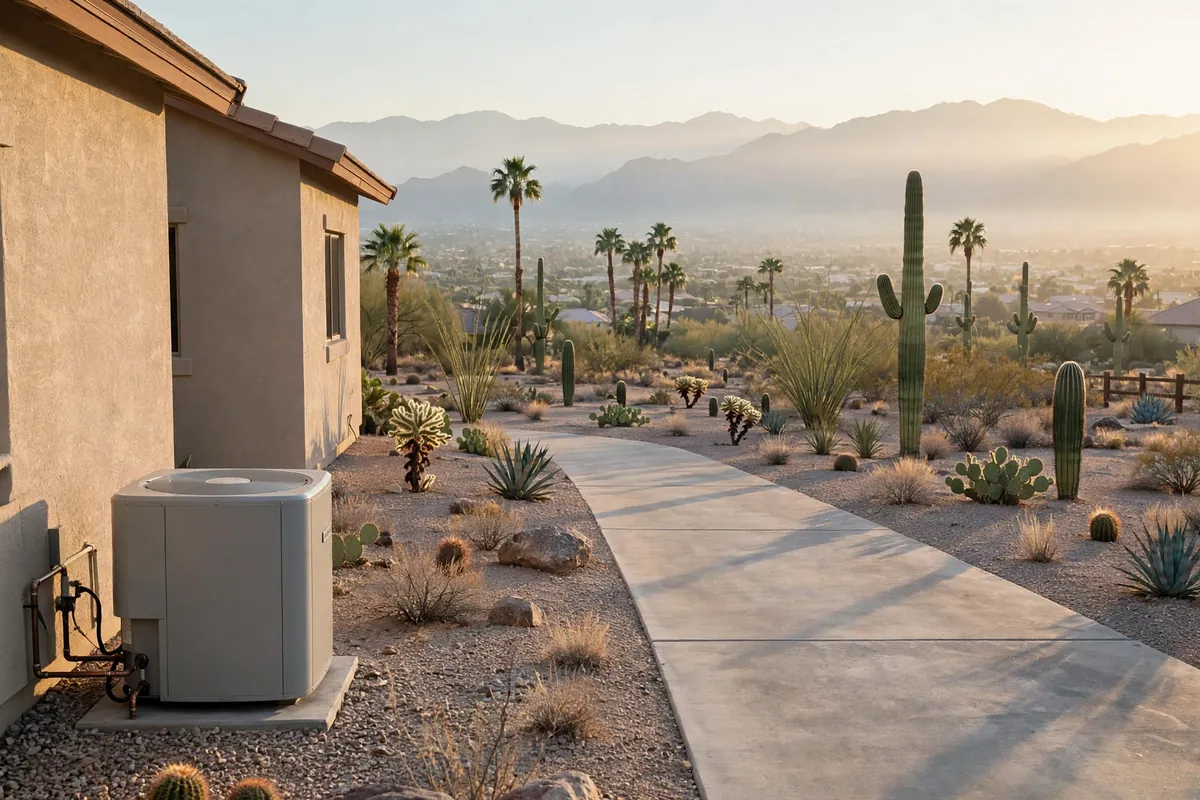
Maricopa County's 4,559,748 residents live with summers shaped by elevation. On this site, its cities operate from Gila Bend — July average elevated 109°F — up to Fort McDowell at 2,646 feet. The desert-floor communities face the complete Arizona summertime; the elevated country trades some of that heat for a genuine winter, where heat pumps earn their keep in both directions.
Repair calls across the county reflect that range. Down low, it is capacity and endurance: systems operating flat out for months. Up elevated, it is two-season equipment and the faults that come with defrost cycles and auxiliary heat. Add housing that runs from historic residences near Phoenix to new subdivisions and rural properties, and no two days of county work watch the identical.
The county seat is Phoenix, and the county publishes its services at www.maricopa.gov — cited under, as on each Maricopa County city page here. The service model is the identical in all of them: one free call, a nearby pro who knows the ground, and a diagnosis explained before any repair is approved.
The work itself follows the county's calendar. Spring is servicing season, when pros work through the county's systems before the heat. Summertime is repair season, when the calls concentrate in the hottest weeks and the longest days. Monsoon season adds its own pattern — dust, drain clogs and surge harm — and the county's higher communities add a winter season of heat pump and heating work on top. A pro who functions Maricopa County year-round plans for all four, and the residents who book their servicing in spring are the ones who rarely meet the other three.
A note on the numbers on this page, because they are the identical ones the city pages stand on: population and housing figures come from the U.S. Census Bureau's American Community Survey, heat figures from NOAA's climate normals for every community's own station, elevation from the USGS, and heat-wave risk from FEMA's National Risk Index. Where a minor community's data is thin — and Maricopa County has a few — the city page says so plainly rather than filling the gap with estimates. Honest data is the entire basis of this site: it is what the rankings, the comparisons and the nearby advice are built from.
Local Factors Behind Maricopa County AC Failures
Cooling in Maricopa County is a study in contrasts. The identical county holds desert-floor heat and elevated-country cold, century-ageing housing and brand-new subdivisions, dense streets and residences a mile from their nearest neighbour. AC systems absorb all of it: the dust of the open desert, the electric struggle of lengthy hot runs, the two-season workload of heat pumps in the hills. Nearby pros read those conditions in each diagnosis — a fault that means one thing in a new suburb means a further in an earlier-built house across the county. The county's spread also rewards the model this site is built on: independent pros who already work their own patch of Maricopa County, reached on one free number, rather than a distant rota sending whoever is free. Nearby knowledge is not a slogan here; in a county this varied, it is most of the job. A note on the numbers on this page, because they are the identical ones the city pages stand on: population and housing figures come from the U.S. Census Bureau's American Community Survey, heat figures from NOAA's climate normals for every community's own station, elevation from the USGS, and heat-wave risk from FEMA's National Risk Index. Where a minor community's data is thin — and Maricopa County has a few — the city page says so plainly rather than filling the gap with estimates. Honest data is the entire basis of this site: it is what the rankings, the comparisons and the nearby advice are built from. The heat figures used across this page come from NOAA / National Weather Service climate normals for every community's own station. The Sonoran Desert climate sets the terms here: lengthy, arid heat broken by monsoon storms, and cooling systems that work harder than nearly anywhere else in the country. The county emergency management office coordinates Maricopa County's heat response every summertime, working with the communities listed over. The county heat relief program maintains a cooling center in Phoenix and others in the county's larger communities during heat events. A central air conditioner in Maricopa County is not an appliance so a great deal of as infrastructure — the system each house here is planned about. Extreme heat defines the county's summers, and it is the single biggest factor in how its cooling systems age.