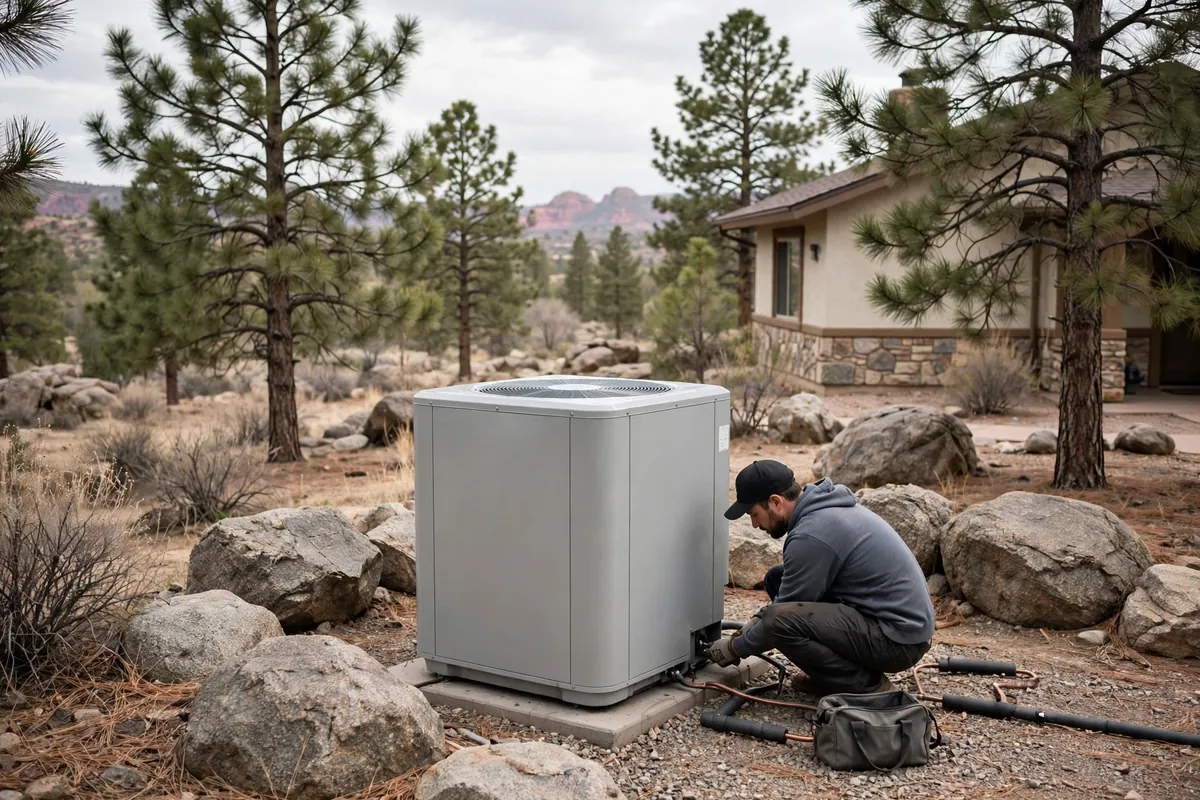
With 245,480 people spread across its communities, Yavapai County asks its cooling systems to work in very different conditions. Black Canyon City records the county's fiercest heat on this site — a July average elevated of 105°F — while Crown King sits at 6,398 feet, where summers are kinder and winters genuinely cold. One county, two climates, and repair work that has to respect both.
Housing across the county is only as mixed: older residences in the established towns, newer builds in the growing suburbs, and manufactured housing in the rural stretches. Each type fails differently, and the visiting pro's first job is knowing which kind of residence they are standing in. That nearby knowledge is part of what the free call connects you with.
Prescott, the county seat, anchors the served cities listed over. County services and records are published on the official site at www.yavapaiaz.gov, which we cite in the sources under. For cooling, the practical point is simpler: wherever in Yavapai County your city sits on this page, the same line hits a pro who works there.
Service coverage follows the population. The cities listed over are where the county's residents are, and each one is covered on the same terms: one free call, a pro who already works the area, typical arrival of 30–60 minutes, and a diagnosis explained before any repair is approved. Smaller settlements between the listed cities are commonly covered by the pro serving the nearest one — the free call is the way to confirm your own address, and you will get an honest answer either way. That model matters in a county like Yavapai, where the alternative — a distant rota dispatching whoever is free — would leave the county's edges waiting longest exactly when the heat is worst.
Residents reading this page in the middle of a failure do not need the complete tour — the number at the top of the page is the shortcut, and the call is free. Everyone else can use the city list over to locate their own community's page, where the same service is described with that city's own heat, housing and neighbourhood data. However you arrive, the promise is consistent across Yavapai County: a nearby pro, a genuine diagnosis, a cost agreed before work, and a unit tested at the vents before the appointment ends.
Local Factors Behind Yavapai County AC Failures
Two facts drive cooling work in Yavapai County: heat and distance. The county's low desert communities endure the same intense summers as the rest of Arizona's hot belt, with July highs at or past 100°F for weeks, while its higher settlements add real winters that create heating faults a second season of work. Systems here give out in both directions — cooling failures in July, heat pump and defrost faults in January — and pros plan for both. Distance is the other steady: communities are spread out, addresses can sit miles apart, and a pro who diagnoses completely on the first appointment saves the county's residents a second long wait. That reality shapes this service — honest arrival windows, vans stocked with the typical parts, and repairs explained completely the first time, since nobody in Yavapai County is well served by a return trip that better diagnosis would have prevented. A note on the numbers on this page, since they are the same ones the city pages stand on: population and housing figures come from the U.S. Census Bureau's American Town Survey, heat figures from NOAA's climate normals for each community's own station, elevation from the USGS, and heat-wave chance from FEMA's National Chance Index. Where a minor community's data is thin — and Yavapai County has a few — the city page says so plainly rather than filling the gap with estimates. Honest data is the entire basis of this site: it is what the rankings, the comparisons and the nearby advice are built from. Ductwork is the county's quiet variable: the same unit chills well or badly depending on the ducts it has to breathe via, and Yavapai County's older residences check that daily. The heat figures used across this page come from NOAA / National Weather Service climate normals for each community's own station. The Sonoran Desert climate sets the terms here: long, arid heat broken by monsoon storms, and cooling systems that work harder than nearly anywhere else in the country. The county emergency management office coordinates Yavapai County's heat response each summertime, functioning with the communities listed over. The county heat relief program maintains a cooling center in Prescott and others in the county's larger communities through heat events. A central air conditioner in Yavapai County is not an appliance so a great deal of as infrastructure — the unit every residence here is planned around. Intense heat defines the county's summers, and it is the single biggest factor in how its cooling systems age.