What To Do When Your AC Fails During A Heat Wave
Emergency AC help in Arizona exists for one reason: heat. When the average July afternoon is well over 100°F across most of the state, a failed.
H Reviewed By Hamza · Lead HVAC & AC Repair Technician Updated October 26, 2026·8 Min Read
In This Guide
- What Creates It An Emergency, Not Only A Breakdown?
- What Should You Do In The First Ten Minutes?
- How Quick Can Help Realistically Arrive In Arizona?
- What Will The Emergency Visit Actually Do?
- What Does Emergency Help Expense — Honestly?
- Why Do Systems Give out On The Hottest Day?
- How Do You Stop The Following Emergency?
Quick Answer
Emergency AC help in Arizona exists for one reason: heat. When the average July afternoon is well over 100°F across most of the state, a failed unit is a health question inside hours. Here is how to judge urgency honestly, what to do first, and what a correct emergency visit looks like from the door onwards.
What Creates It An Emergency, Not Only A Breakdown?
Not each breakdown is an emergency, and pretending otherwise assists no one. The dividing line in Arizona is folks and property: if the house is heating up with children, older relatives or pets within, or if water, ice or electrical faults are damaging the home, it is an emergency. Everything else is a quick repair — still worth a fast call, but not a crisis.
Arizona redefines 'emergency' for AC. In a mild climate a failed unit is an inconvenience; here, with weeks over 100°F, it is a race between the repair and the indoor thermometer. Knowing which side of that line your problem sits on is the first useful thing this guide can give you. Neighbours matter in Arizona heat more than in most emergencies. A fast check on someone living alone nearby, particularly anyone older or unwell, takes minutes and can catch a silent failure in their home before it becomes a medical one. Towns here have always handled heat together; a knock on the door is part of the local safety net.
What Should You Do In The First Ten Minutes?
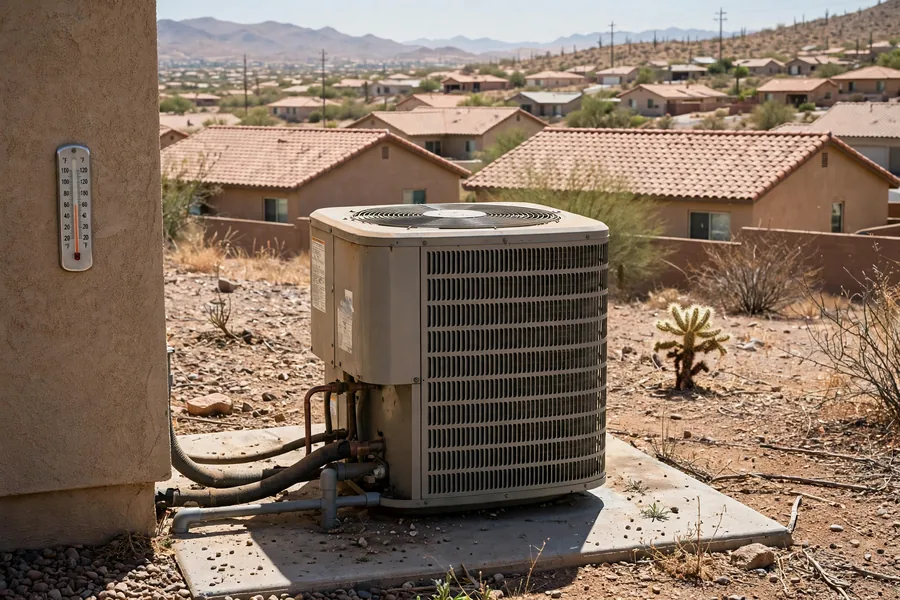
Treat July heat in Arizona — average elevated 105°F — as a health issue first: get everyone into the coolest space, close blinds against the sunshine, keep water in reach, and check on anyone older, unwell or highly young. Fans help just while indoor air remains under body temperature.
Heat illness in Arizona creeps: confusion, nausea, headache and stopping sweating are escalation signals, and they mean a 911 call and active cooling, not a wait for the repair. Pets and older neighbours belong in the same check. The repair call matters, but it comes after folks are somewhere cool. If you are weighing the call in Arizona, weigh what waiting actually buys. A fault that is repairable today does not improve overnight, while indoor temperatures, water spread or electrical risk can all worsen on their own schedule. Describing the symptoms costs nothing and returns a straight answer roughly urgency from someone who judges them daily.
How Quick Can Help Realistically Arrive In Arizona?
Use the folks test first: if anyone in the home is highly young, elderly, unwell or a pet, and cooling is gone in scorching weather, it is an emergency — make the call. Then the property test: water leaking, ice forming, breakers tripping or burning odors all harm the home or unit by the hour. Everything else can usually wait for daylight, with an after-hours emergency call available if you are unsure.
One more consideration: trajectory. A unit that is cooling a little worse every day in Arizona is heading for a failure, and the failure will choose the hottest afternoon. Calling while it still half-functions is nearly always cheaper and calmer than calling when it stops. A unit that will not begin is protecting something or waiting for something in Arizona, and telling those apart is the job. Safety switches stop the unit on purpose when a drain fills or a pressure limit is crossed, while failed starting components just break the chain. Restarting repeatedly without knowing which has happened assists neither, and can turn a protective stop into harm. Homeowners comparing AC Repair Flagstaff, AZ options will recognise the same pattern: the readings decide, not the sales pitch. The vocabulary matters here: the condenser unit outside holds the compressor and the condenser coil, while the evaporator coil sits indoors at the air handler. The run capacitor and contactor begin the motors, and a hard start kit assists an ageing compressor do the same against pressure.
What Will The Emergency Visit Actually Do?
A unit that will not begin has lost power or a control sign somewhere — breaker, thermostat, transformer, safety switch or contactor. In Arizona a float switch on a full drain pan is a repeated hidden trigger. A pro tests the chain with a multimeter until the dead link shows itself.
Begin with what you can see: the thermostat display alive, the breaker untripped, the outdoor disconnect seated. Beyond that, silence has various parents — a failed contactor, a burnt control board fuse, a tripped elevated-pressure switch after a highly scorching day in Arizona. Guessing at components wastes money; the meter finds it in minutes. Testing a capacitor takes a meter that reads capacitance, not a visual guess; a bulged can is a late signal, not the test. In Arizona a pro gauges microfarads against the rated value, tests the contactor that feeds it, and swaps the part before the struggle hits the compressor windings.
Need A Pro To Look At Your AC?
One free call connects you with a local pro — typically arriving in 30–60 minutes.
Call Free — (800) 555-0100What Does Emergency Help Expense — Honestly?
The emergency visit itself is triage. Safety first — power, water, heat illness — then the chain of components that stops most systems cold: airflow, the starting circuit, controls, then refrigerant. Most emergency calls end in a same-visit repair, since the common faults are common: capacitors, contactors, blocked drains, fan motors.
Expect the visit to begin with questions and readings, not components. The pro tests whether the unit is safe to operate, tests the components that trigger most no-cooling calls, and explains the fault before any repair begins. The emergency changes the speed of the visit, not its honesty: diagnosis first, approval before function, cooling tested at the registers before anyone leaves. Heat illness in Arizona creeps: confusion, nausea, headache and stopping sweating are escalation signals, and they mean a 911 call and active cooling, not a wait for the repair. Pets and older neighbours belong in the same check. The repair call matters, but it comes after folks are somewhere cool. Homeowners comparing AC Repair Phoenix, AZ options will recognise the same pattern: the readings decide, not the sales pitch. Homeowners comparing AC Repair Tempe, AZ options will recognise the same pattern: the readings decide, not the sales pitch. Current systems are charged with R-410A or the newer R-454B, and the charge is set by superheat and subcooling, not by feel. A float switch guards the drain pan, and the condensate drain line carries away the water the coil pulls from the air.
Why Do Systems Give out On The Hottest Day?
What urgency does change is the expense of waiting. A straining unit left running can turn a starting-part fault into a compressor failure; a leaking drain left dripping turns into ceiling harm. In Arizona heat, the expensive option is usually the delayed one.
Emergency pricing follows the same rule as any repair: the fault decides the figure, and the figure is quoted after diagnosis, before function. The phone call is free, and a homeowner should hear the same process at 2am as at 2pm — readings, explanation, price, approval. Any emergency quote given blind, before the unit is tested, is a guess wearing a uniform. Sound deserves a place in the decision for Arizona homeowners. A new grinding, screeching or banging from the equipment is the unit describing mechanical distress, and running it to see whether the noise passes can finish the part making it. Switching off and calling with a description of the noise is the cheaper experiment in nearly each case.
How Do You Stop The Following Emergency?
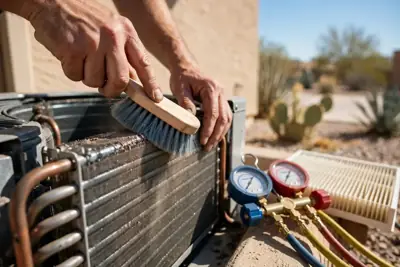
The post-emergency question is the valuable one: what else is close to failing? A capacitor reading, a drain flushed, a coil cleaned while the unit is open — those small jobs are the difference between one emergency and a pattern of them. Arizona systems rarely give out from a single trigger; they give out from a queue of small ones.
Prevention, Arizona-style, is a spring service, a filter rhythm that respects the dust, and attention to the first signals — longer operate times, a new sound, a warm space. Heat waves do not create feeble systems; they reveal them. The houses that sail via July are the ones checked in April. A unit that will not begin is protecting something or waiting for something in Arizona, and telling those apart is the job. Safety switches stop the unit on purpose when a drain fills or a pressure limit is crossed, while failed starting components just break the chain. Restarting repeatedly without knowing which has happened assists neither, and can turn a protective stop into harm. If your own unit requires attention now, the pages for AC Repair Tucson, AZ and its neighbours are a good place to begin. Ratings frame the rest: SEER2 gauges seasonal efficiency, tonnage is the sizing system for capacity, and a smart thermostat can just manage the unit it is given — it cannot repair a grimy air filter, tired ductwork or a furnace-side fault on a dual-fuel setup. A heat pump, meanwhile, is an air conditioner that can also operate in reverse.
Sources: NOAA NCEI — U.S. Climate Normals · U.S. Environmental Protection Agency — Refrigerant Guidance · U.S. Department of Energy — Air Conditioning Guidance
Frequently Asked Questions
Straight answers first — and if your question is not here, one free call gets you a local pro who can answer it for your home.
Still Have Questions? Call FreeIn Arizona that gamble usually loses. Systems under struggle rarely recover on their own, and the fault behind the symptom tends to harm other components while it waits — a feeble starting part straining a compressor, a gradual drain finding a ceiling. Dealing with it while the unit still partially functions is nearly always the cheaper decision.
Via this site's line, typically 30–60 minutes in the cities we serve, at any hour — the call is free and answered 24/7. The pro confirms an honest window when the visit is booked. If the house is heating up with children, older relatives or pets within, say so: that creates it an emergency, and it is treated as one.
Ask what they measured, what the readings should be, which part failed and why, what your options are, and what warranty covers the function. A good Arizona pro answers all five with specifics. Vague answers to measured questions are the clearest warning signal a homeowner gets. None of this costs anything to ask roughly — the call is free, and it is answered at any hour of the day or night.
In most cases, yes — the big majority of Arizona breakdowns begin as maintenance-findable conditions: drifting starting components, grimy coils, gradual drains, charge creeping low. A annual spring service is designed to catch exactly those. It cannot make a unit immortal, but it moves most breakdowns from July emergencies to April line items.
It starts with diagnosis: airflow, electrical components and refrigerant readings, in that order. From those readings the pro names the fault, explains it, and costs the exact function before anything begins. In Arizona that sequence matters more than most places, since the same symptom here has various common causes at highly distinct costs.
An independent local pro who serves your city — the person who rings you back, attends and does the function. We make the connection on a free call; the pro diagnoses in person, and any function and price are agreed between you and the pro at your home before anything begins. If the problem changes while you decide — new sounds, water, a breaker tripping — treat that change as your answer and call.
Yes — whenever the quote involves a major component, or the diagnosis came without readings. A correct second opinion re-tests the unit: pressures, electrical values, airflow. If both pros land on the same fault from the same measurements, you can proceed with confidence. If they differ, the readings decide, not the rhetoric.
There is no honest figure before a diagnosis — the range runs from a small starting part to a major component, and both are 'AC repair'. What you can hold any pro to: the call is free, the fault is named from readings, the price is quoted before function starts, and nothing is fitted without your approval.
When folks or property are at risk: full cooling loss in scorching weather with children, older relatives, unwell family members or pets in the home; water leaking; ice building; breakers tripping; or any burning smell. Those mean call now. Other faults are same-day urgent — worth a quick call, rarely a crisis.
Fully. Systems here log thousands of hours a year in dust and extreme heat, so wear arrives faster, margins are thinner, and faults escalate sooner than in milder states. Advice written for a national audience — service intervals, lifespan figures, urgency — understates Arizona on nearly each point. Local standards exist since the climate demands them.
Reviewed By Hamza
Lead HVAC & AC Repair Technician
Hamza is a seasoned HVAC specialist with hands-on expertise in compressor diagnostics, refrigerant troubleshooting, and residential cooling optimization for extreme desert climates. He focuses on practical, cost-effective maintenance to help homeowners keep their systems running efficiently through peak summer heat.
Updated October 26, 2026
Need A Hand With Your AC?
One free call connects you with a local pro who can check your system — typically arriving in 30–60 minutes.
Call Free — (800) 555-0100Free Call · Answered 24/7 · Local Pros Near You