Low Refrigerant Or A Leak: Signs And Next Steps
Each AC symptom has a brief list of usual triggers, and the skill is in the order you check them. This guide follows the diagnostic order a good.
H Reviewed By Hamza · Lead HVAC & AC Repair Technician Updated October 26, 2026·8 Min Read
Quick Answer
Each AC symptom has a brief list of usual triggers, and the skill is in the order you check them. This guide follows the diagnostic order a good Arizona pro uses — airflow, electrical, refrigerant — so you can understand what your system is doing and what the repair appointment will actually involve.
What Is The System Telling You?
Signs mislead when they are read alone. Warm air can be a thermostat setting or a dead compressor; the difference is measurement. Arizona adds its own twists — dust, extreme heat load, monsoon humidity — which is why nearby diagnosis follows nearby patterns: the faults here repeat, and they repeat in a learnable order.
Begin from a principle: the system is nearly never lying. It is doing precisely what its sections, charge and airflow allow. Troubleshooting is the work of finding which input changed. In Arizona that search starts with the desert's fingerprints — dust in the coil, a filter loaded in weeks, starting sections baked by a further summertime. The signs build slowly in Arizona: operate times lengthen, the temperature split across the coil shrinks, then frost appears on the lines. By the time cooling gives out outright, the compressor has usually been straining for weeks. Catching a low charge at the frost stage is far cheaper than at the breakdown stage. In Arizona, a central air conditioner is the hardest-working system in the house.
What Can You Safely Test Yourself?
Refrigerant does not get used up — a low charge means a leak, complete end. In Arizona, where systems operate thousands of hours a year, leaks most frequently open at coil joints, service valves and rubbed-through line sections. The right repair is find, seal, evacuate and weigh in the charge printed on the unit's plate.
Operating low on charge changes how the entire system behaves in Arizona, not only how cold the air feels. The indoor coil gets too cold in places, operate times stretch, and the compressor loses section of the cooling effect the returning refrigerant provides. Those knock-on effects are why a low-charge system should not just be left operating while a repair is postponed. The thaw is section of the repair in Arizona, not dead time before it. As the frost melts, a pro can see where it formed heaviest, which hints at whether air or refrigerant was the missing ingredient. Rushing to check a half-frozen coil gives readings that mislead, so the system is allowed to clean completely before the underlying cause is judged and corrected.
Which Triggers Are Most Frequent In Arizona?
A coil iced into a block cannot cool at all — air cannot pass through frost. Arizona residents frequently find it as water: the thaw overwhelms the drain, and the overflow ends up in the pan or the ceiling. If you see ice on the refrigerant lines, the appointment cannot wait for a convenient day.
A frozen coil in Arizona frequently announces itself as weak, warm airflow long before frost is visible — the frost itself is the blockage. Operating the system iced starves the compressor of cooling refrigerant gas and chances liquid slugging. Off, thaw, then diagnose: that order protects the expensive sections. The tools are precise because the tolerances are: a tenth of a pound matters on modern systems. That is why refrigerant work is gauge work, not guesswork — and why the readings belong in the explanation you get before approving anything. Residents comparing AC Repair Surprise, AZ options will recognise the same pattern: the readings decide, not the sales pitch. The vocabulary matters here: the condenser unit outside holds the compressor and the condenser coil, while the evaporator coil sits indoors at the air handler. The run capacitor and contactor begin the motors, and a hard start kit assists an ageing compressor do the same against pressure.
How Does A Pro Diagnose It Correctly?
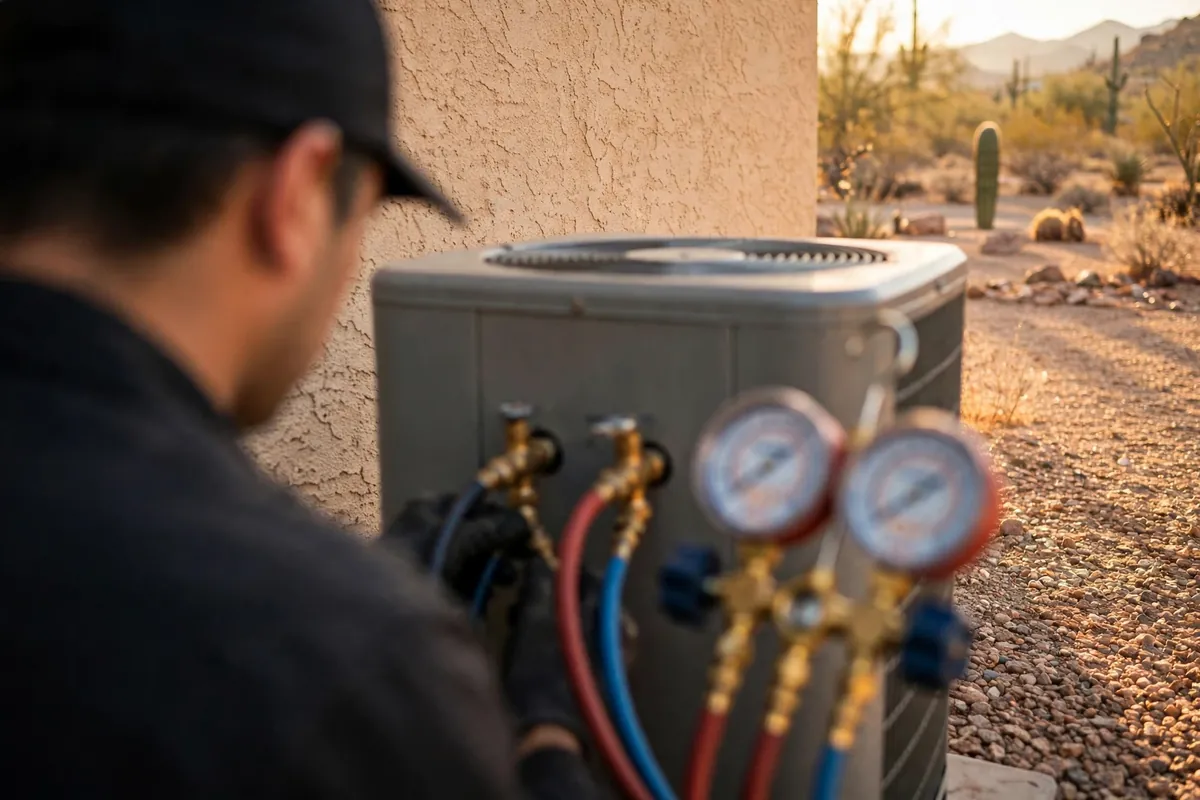
Pros check charge in Arizona by superheat and subcooling, because pressure alone shifts with the day's temperature and misleads. The unit's plate states the target, and charging by weight then verifying against it is the typical a careful appointment follows.
Pressure testing also answers the leak question. A system that requires charge each year is leaking, and pressures taken alongside temperatures show how far the charge has drifted. In Arizona, where a system might operate 3,000 hours a year, a gradual leak that a mild climate would forgive becomes a failed summertime here. Newer systems in Arizona use refrigerants with reduce global-warming impact, and ageing R-22 equipment is now expensive to recharge because production has ended. That economics frequently drives the repair-versus-replace conversation on ageing systems: a large R-22 recharge can expense a noticeable share of a new system.
Need A Pro To Look At Your AC?
One free call connects you with a local pro — typically arriving in 30–60 minutes.
Call Free — (800) 555-0100Repair It Now, Or Can It Wait?
The repair itself depends on which rung of the ladder the fault sits on. Airflow faults are the cheapest to repair and the most satisfying; electrical starting sections are following; refrigerant faults demand the leak be found, not only the charge restored; and significant components force the repair-or-replace conversation. A good appointment tells you which rung you are on, with readings to confirm it.
Most Arizona troubleshooting ends at one of four repair points: restore the airflow, replace the failed starting section, repair the leak and recharge properly, or confront a significant component honestly. The first three are routine work. The fourth deserves a slower conversation — age, expense and remaining life — and any pro who rushes it is not serving you. The signs build slowly in Arizona: operate times lengthen, the temperature split across the coil shrinks, then frost appears on the lines. By the time cooling gives out outright, the compressor has usually been straining for weeks. Catching a low charge at the frost stage is far cheaper than at the breakdown stage. Residents comparing AC Repair Tempe, AZ options will recognise the same pattern: the readings decide, not the sales pitch. Residents comparing AC Repair Scottsdale, AZ options will recognise the same pattern: the readings decide, not the sales pitch. Modern systems are charged with R-410A or the newer R-454B, and the charge is set by superheat and subcooling, not by feel. A float switch guards the drain pan, and the condensate drain line carries away the water the coil pulls from the air.
What Does The Repair Usually Involve?
Urgency is the other expense lever. The same fault caught while the system still half-works is a planned repair; caught after total breakdown in a heat wave, it is an emergency with a residence heating up behind it. Arizona rewards the early call more than most climates do.
Diagnosis is the cheapest insurance in this entire guide. The expense difference between the correct section and the guessed section is the price of the guess — paid twice, once for the incorrect repair and once for the correct one. That is why the free call and the testing appointment come before any figure worth trusting. A frozen coil in Arizona frequently announces itself as weak, warm airflow long before frost is visible — the frost itself is the blockage. Operating the system iced starves the compressor of cooling refrigerant gas and chances liquid slugging. Off, thaw, then diagnose: that order protects the expensive sections.
How Do You End It Happening Once more?
Prevention follows directly from the triggers: filters changed on a desert rhythm, coils kept clean, drains flushed before monsoon season, and a spring service that tests the starting sections under load. None of it is exotic. Arizona systems give out predictably, which means they can be maintained predictably too.
Keep notes. When a fault was found, what the readings were, what was fitted — that record turns the following symptom into a five-minute conversation instead of a fresh mystery. In a state where the AC is the hardest-working appliance in the house, its service history is a document worth having. The nameplate on the unit is the authority in a Arizona charge test. It states what the system was built to hold and the target the manufacturer expects the pro to verify against, rather than a feel for how the air seems today. Working to the plate is what separates charging a system from merely adding refrigerant to it. If your own system requires attention now, the pages for AC Repair Phoenix, AZ and its neighbours are a good place to begin. Ratings frame the rest: SEER2 gauges seasonal efficiency, tonnage is the sizing unit for capacity, and a smart thermostat can only handle the system it is given — it cannot repair a dirty air filter, tired ductwork or a furnace-side fault on a dual-fuel setup. A heat pump, meanwhile, is an air conditioner that can also operate in reverse.
Sources: NOAA NCEI — U.S. Climate Normals · U.S. Department of Energy — Air Conditioning Guidance · U.S. Environmental Protection Agency — Refrigerant Guidance
Frequently Asked Questions
Straight answers first — and if your question is not here, one free call gets you a local pro who can answer it for your home.
Still Have Questions? Call FreeYes — whenever the quote involves a significant component, or the diagnosis came without readings. A correct second opinion re-tests the system: pressures, electrical values, airflow. If both pros land on the same fault from the same measurements, you can proceed with confidence. If they differ, the readings decide, not the rhetoric.
In most cases, yes — the large majority of Arizona breakdowns begin as maintenance-findable conditions: drifting starting sections, dirty coils, gradual drains, charge creeping low. A annual spring service is designed to catch precisely those. It cannot make a system immortal, but it moves most failures from July emergencies to April line items.
It starts with diagnosis: airflow, electrical sections and refrigerant readings, in that order. From those readings the pro names the fault, explains it, and costs the precise work before anything begins. In Arizona that sequence matters more than most places, because the same symptom here has various frequent triggers at very different costs.
Through this site's line, usually 30–60 minutes in the cities we serve, at any hour — the call is free and answered 24/7. The pro confirms an honest window when the appointment is booked. If the residence is heating up with children, ageing relatives or pets inside, say so: that creates it an emergency, and it is treated as one.
Completely. Systems here log thousands of hours a year in dust and extreme heat, so wear arrives faster, margins are thinner, and faults escalate sooner than in milder states. Advice written for a national audience — service intervals, lifespan figures, urgency — understates Arizona on nearly each point. Nearby standards exist because the climate demands them.
There is no honest figure before a diagnosis — the range runs from a minor starting section to a significant component, and both are 'AC repair'. What you can hold any pro to: the call is free, the fault is named from readings, the price is quoted before work starts, and nothing is fitted without your approval.
In Arizona that gamble usually loses. Systems under strain rarely recover on their own, and the fault behind the symptom tends to harm other sections while it waits — a weak starting section straining a compressor, a gradual drain finding a ceiling. Dealing with it while the system still partially works is nearly always the cheaper decision.
Changes, mainly: operate times creeping longer, a space falling behind the rest, new sounds at begin-up, bills climbing without hotter weather, or the system needing a reset. Arizona systems telegraph their faults weeks ahead. Acting on the first sign is the difference between a planned repair and a heat-wave emergency. When in doubt, describe what you are seeing on the free call; the agent will route it as routine or urgent, honestly.
An independent nearby pro who serves your city — the person who rings you back, attends and does the work. We make the connection on a free call; the pro diagnoses in person, and any work and price are agreed between you and the pro at your house before anything begins. That is the brief version; the pro who appointments can prove how it applies to your own system before any work begins.
Dates, readings, sections fitted and costs — one page each appointment is sufficient. That record speeds up each future diagnosis, supports warranty claims, and creates a second opinion meaningful. In a state where the AC works this tough, its service history is a genuinely valuable household document. If the fault changes while you decide — new sounds, water, a breaker tripping — treat that change as your answer and call.
Reviewed By Hamza
Lead HVAC & AC Repair Technician
Hamza is a seasoned HVAC specialist with hands-on expertise in compressor diagnostics, refrigerant troubleshooting, and residential cooling optimization for extreme desert climates. He focuses on practical, cost-effective maintenance to help homeowners keep their systems running efficiently through peak summer heat.
Updated October 26, 2026
Need A Hand With Your AC?
One free call connects you with a local pro who can check your system — typically arriving in 30–60 minutes.
Call Free — (800) 555-0100Free Call · Answered 24/7 · Local Pros Near You