How Often Should You Service Your AC In Arizona?
How often an Arizona AC really needs servicing, what a visit includes, and when to book it — plain answers for desert homes where the cooling season runs long and hard.
H Reviewed By Hamza · Lead HVAC & AC Repair Technician Updated October 26, 2026·7 Min Read
In This Guide
- How Often Should You Service Your AC In Arizona?
- What Does An AC Service Visit Include?
- Which Month Should You Book AC Service In Arizona?
- What Are The Signs You Waited Too Long For AC Service?
- Do Older Systems And Heavy Daily Use Need Service More Often?
- How Often Should You Change The Filter Between Visits?
- What Affects The Cost Of AC Service?
Quick Answer
In Arizona, service your AC once a year at minimum, in spring before the serious heat arrives. Homes with older systems, or a central AC that runs ten or more hours a day through summer, do better with a second visit each year. Between visits, check the filter monthly, because desert dust loads it faster than in milder states, and a clogged filter can cut cooling and raise bills.
How Often Should You Service Your AC In Arizona?
In Arizona, service your AC once a year at minimum, and twice a year if the system is older or runs nearly all day. One yearly visit is the floor here, because the cooling season is long and the runtime is heavy.
In a mild state, a system runs a few hours a day for two or three months. A central AC in Arizona can run ten or more hours a day from May into October, stacking up several times the wear in a single season. Homeowners reading about AC Repair Phoenix, AZ often discover their system has effectively worked two or three mild-climate years in one summer. Yearly service, with a second visit for hard-working systems, matches the maintenance to the actual workload.
What Does An AC Service Visit Include?
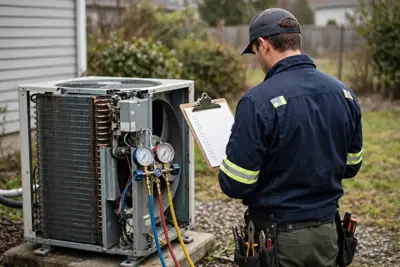
A proper service visit covers the coils, the charge level, electrical parts, drain line, filter, and thermostat. It is a working inspection, not a quick glance, and it usually takes a pro about an hour.
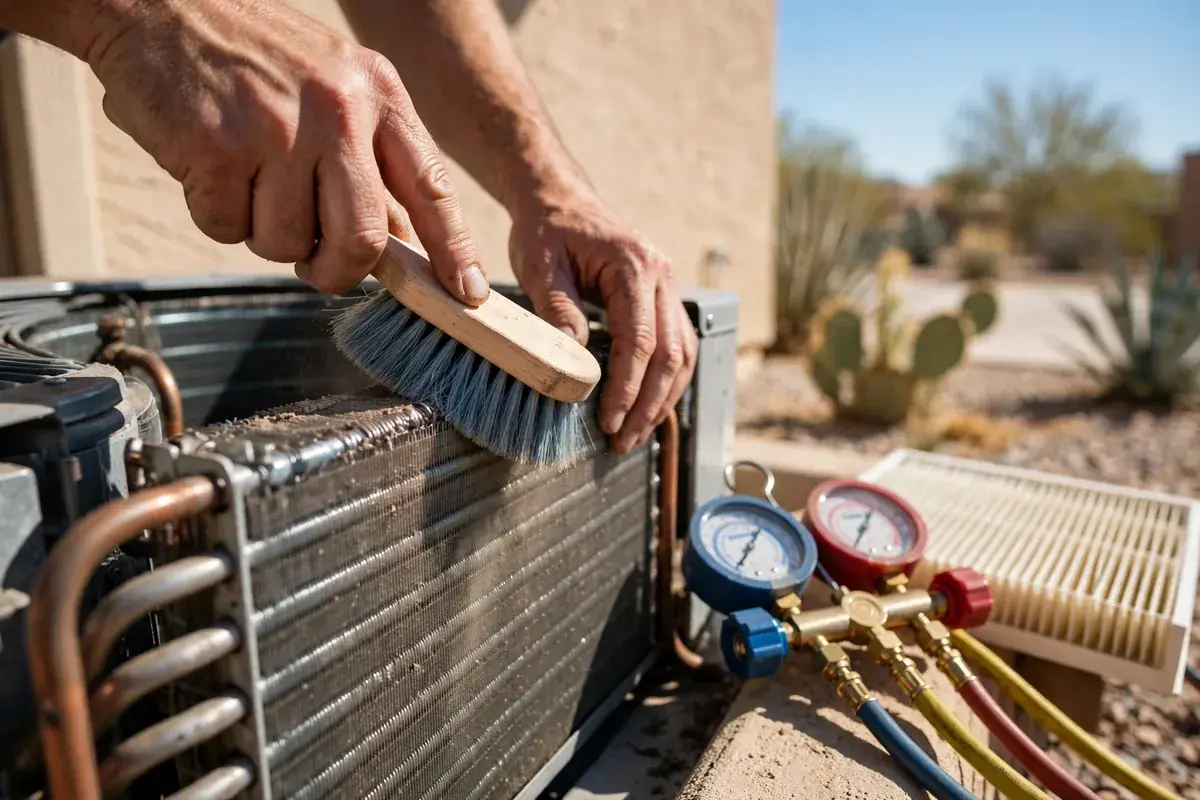
The visit starts with the evaporator coil and condenser coil, which are cleaned so the system can move heat properly, and the refrigerant level, checked with readings such as superheat to confirm the charge is right. Electrical parts come next: the run capacitor and contactor are tested, connections are tightened, and the blower motor draw is checked. The condensate drain line is flushed, the float switch is tested, and the drain pan is checked. Static pressure readings show whether ductwork is restricting airflow, the TXV operation is reviewed, and the air filter and thermostat finish the list.
Which Month Should You Book AC Service In Arizona?
Book in spring, ideally March or April, before the first run of 100-degree days. Spring appointments are easier to get, and any problem found can be fixed before you actually need the cooling.
By late May, every pro in the state is busy, and a worn part found then can mean waiting while the house heats up. A spring visit also clears away winter dust before it bakes onto the condenser unit, and it leaves time to plan a bigger repair instead of approving one in a panic. Readers looking into AC Repair Mesa, AZ in spring are usually booked within days, while the same call in mid-June can land in the busiest week of the year. A thorough visit can also flag a weakening capacitor that a hard start kit would support, compare superheat and subcooling readings with the tonnage (AC sizing) the home actually needs, and check the furnace blower in combined systems, since the same blower moves cooled air all summer.
What Are The Signs You Waited Too Long For AC Service?
Weak cooling, rising bills, new noises, water near the unit, and frequent on-off cycling are the clearest signs you waited too long. Each one means a small issue has had time to grow into a repair.
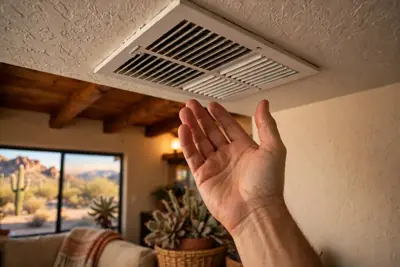
Warm air from the vents often means the compressor has been struggling with a low charge or dirty coils for weeks. Water stains or a musty smell near the indoor unit suggest the drain has been clogging slowly, and short cycling — the unit starting and stopping every few minutes — wears the compressor every time it happens. These become emergencies on the first 110-degree afternoon, which is exactly when a yearly visit would have caught them.
Need A Pro To Look At Your AC?
One free call connects you with a local pro — typically arriving in 30–60 minutes.
Call Free — (800) 555-0100Do Older Systems And Heavy Daily Use Need Service More Often?
Yes — systems over about ten years old, and any system running ten or more hours a day, benefit from service twice a year. Age and runtime, not the calendar, decide how much attention a unit needs.
Older equipment runs on parts that have survived thousands of heat cycles, and a capacitor or motor that tests fine in April can fade by August. Outlying homes work systems especially hard; a household checking AC Repair Apache Junction, AZ after a breakdown often learns the unit runs from morning to midnight. Older systems may use R-410A while newer ones run R-454B, and each needs its charge checked correctly. A system's SEER2 rating describes efficiency when new — after a decade of summers, only a visit shows how it performs now. A spring visit plus a mid-season check suits high-use heat pump systems too.
How Often Should You Change The Filter Between Visits?
Check the filter every month during the cooling season and change it as soon as it looks loaded — in dusty months, that can mean monthly changes. A clogged filter is the most common cause of weak airflow homeowners can fix themselves.
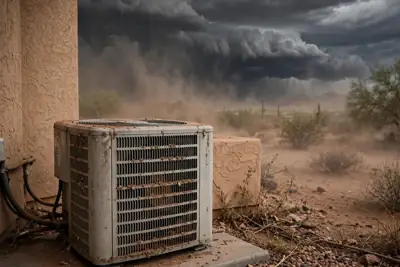
Arizona dust does not follow the schedule printed on the filter packaging, which assumes a milder climate. During monsoon dust season, a filter in a busy home can load up in a few weeks, and a choked filter forces the whole system to work harder, raises bills, and can even contribute to a frozen coil. Write the change date on the filter frame when you fit it, and keep a spare on hand.
What Affects The Cost Of AC Service?
The cost of AC service depends on the system's size, age, access, refrigerant type, and what the visit actually finds — not on a single flat figure. Understanding the factors helps you read any quote sensibly.
A compact system with an easily reached air handler costs a pro less time than a large unit in a hot attic, and time is a real factor. Refrigerant top-ups, where needed, vary by type and amount, and a system on R-454B is handled differently from an older one. Replacing a failing capacitor takes a pro far less time than work involving the compressor or ductwork. Extras you choose, such as a smart thermostat fitted during the visit, add to the cost as well. Ask for the factors to be explained line by line before you agree to anything.
Sources: NOAA NCEI — U.S. Climate Normals · U.S. Department of Energy — Air Conditioning Maintenance Guidance · U.S. Census Bureau — American Community Survey
Frequently Asked Questions
Straight answers first — and if your question is not here, one free call gets you a local pro who can answer it for your home.
Still Have Questions? Call FreeFor most Arizona homes, yes. A spring visit prepares the system for the heavy season, and a shorter check in late summer catches wear the long hot months caused — a fading electrical part, a slow drain, a filter routine that is not keeping up. Older systems and dusty homes benefit most. If your system is newer and lightly used, one thorough yearly visit is a reasonable pattern instead.
Early fall is the second sensible window. The rush is over, pros have more open time, and a visit then sorts out wear from the summer just gone, leaving a heat pump ready for its winter heating work. What matters is not the exact month but the rhythm: once a year, every year, at roughly the same time. Waiting until the system fails in June turns a planned visit into an emergency repair.
Skipping one year on a newer, healthy system rarely causes instant harm, but the risk builds quietly. Dust coats the coils more, drain algae grows undisturbed, and a weakening electrical part gets another full summer of strain. By the second skipped year, most systems run less efficiently and are far more likely to fail during a heat wave. Missed a year? Book a visit now rather than waiting for next spring.
A thorough visit usually takes around an hour for a standard home system, longer with two systems, awkward attic access, or a problem worth investigating. The system is off for parts of the visit, so on a mild spring day you will barely notice. Booking ahead of the hot season also means the pro is not rushing between emergency calls, so the inspection gets its proper, unhurried attention.
In everyday use, the two terms mean much the same thing: a planned visit where a pro cleans, checks, and adjusts your system. Some pros use one word, some the other, and some offer a lighter check under one name and a longer visit under the other. Compare visits on what they include — coils, electrical parts, drain, airflow, controls — not on the label, and ask what is covered before you book.
Some parts, yes: changing filters, keeping the outdoor unit clear of weeds and stored items, and gently rinsing dust off the outside of the unit are sensible homeowner jobs. The rest belongs to a pro. Work on the sealed system, electrical panels, and capacitors involves real hazards and specialist tools, and a mistake can turn a small fault into an expensive one. You handle the monthly basics; the yearly visit covers the technical checks.
Any season can work, but spring has real advantages: open appointment books, mild weather while the system is off, and time to fix anything found before you depend on cooling daily. Avoid planning service at the peak of summer, when pros are fully committed to breakdowns. Reading this in summer with a working system? Book anyway — a system checked in July is still far better off than one checked never.
Yes, for two reasons. A new system still collects dust through an Arizona summer, still drains condensate, and benefits from an early check that everything performs as it should after its first full season. And catching a small installation issue early, while it is small, is far simpler than finding it years later. Start the yearly rhythm with the home, not the system's age, and keep the visit records with your house paperwork.
It lowers the risk a lot, because most breakdowns begin as small, findable problems: a weakening capacitor, a slow drain, a low charge, dirty coils — exactly what a yearly visit is designed to catch. It cannot make an old system young or foresee every sudden failure, so treat service as strong prevention, not a promise. Paired with monthly filter checks and a spring booking, it is the realistic maximum for uneventful summers.
Book as soon as you know you want it — in spring, that can mean calling a few weeks ahead. If a pro's calendar is full, ask about any cancellation list, and keep up your monthly filter changes meanwhile so the system is not straining. If symptoms appear — weak cooling, new noises, water near the unit — say so when you call, since a system showing faults needs attention sooner than a routine visit.
Reviewed By Hamza
Lead HVAC & AC Repair Technician
Hamza is a seasoned HVAC specialist with hands-on expertise in compressor diagnostics, refrigerant troubleshooting, and residential cooling optimization for extreme desert climates. He focuses on practical, cost-effective maintenance to help homeowners keep their systems running efficiently through peak summer heat.
Updated October 26, 2026
Not Sure When Your AC Was Last Serviced?
One free call connects you with a local pro who can check your system and set a sensible service rhythm.
Call Free — (800) 555-0100Free Call · Answered 24/7 · Local Pros Near You